
Apostille

What is an Apostille?

Have you been asked to obtain an apostille?
Planning to use your documents internationally?

Whether you’re getting married abroad, studying overseas, applying for immigration or visas, or working overseas, you may need an apostille.

An apostille is an official certificate that authenticates your documents for use in foreign countries. It is commonly required for documents such as birth certificates, diplomas, powers of attorney, and other official records.

Apostille vs. Authentication

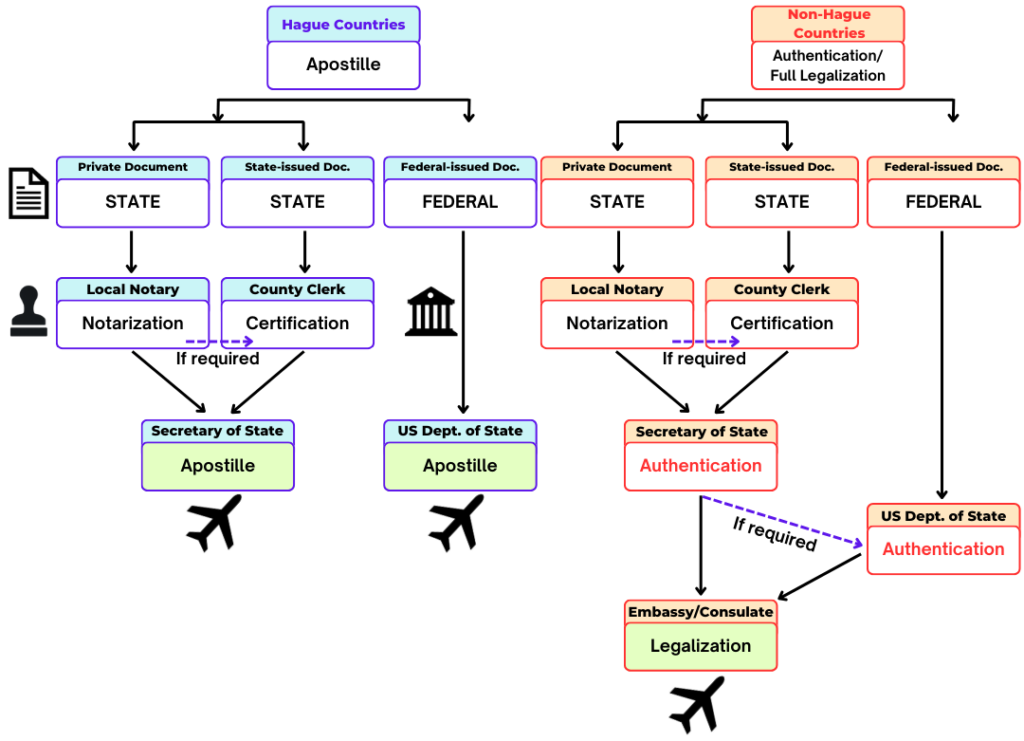
Authentication is the process of verifying a public document (such as a birth certificate, marriage certificate, or academic record) to ensure it is legally recognized abroad. The authentication procedure depends on whether the destination country is a member of the Hague Apostille Convention. If it is a member, the document will be authenticated using an apostille. If it is not a member, the document will undergo full legalization for authentication. Learn more about the Hague Conference and the ABCs of Apostilles.

Apostille Procedure

If the destination country is a member of the Hague Apostille Convention, the Secretary of State (or designated authority) issues an apostille certificate for both state/county-issued documents and private/corporate documents. For federal government-issued documents, including FBI background checks, the U.S. Department of State issues the apostille certificate.

Full Legalization Procedure

If the destination country is not a member of the Hague Apostille Convention, the document must go through full legalization. This usually involves:

  • Certification by the Secretary of State (or equivalent state authority)
  • Authentication by the U.S. Department of State in Washington, D.C.
  • Legalization at the foreign country’s consulate or embassy in the U.S.

Be advised that the roster of Hague Convention countries is subject to change. For the most current and official list, refer to the following link: HCCH Status Table

Authentication At a Glance

The apostille and full legalization procedures are outlined below.
Types of Documents That Are Typically Required for an Apostille

  • Certified copy from the state vital records office, county clerk, or the State Registrar (California Department of Public HealthForms). More information.
  • Obtain a certified birth record from the County Registrars and Recorders in the county of the birth registration or the California Department of Public Health: Obtaining Certified Copies of Birth Certificates, or order online at VitalCheck.
  • If your birth or death certificate was issued by a city- or county-level agency and signed by a local health or registrar official, additional certification by the appropriate county clerk may be required before state authentication can be requested. More Information.
  • Certified copies may be obtained by the registrant, a parent or legal guardian, child, grandparent, grandchild, sibling, spouse, domestic partner, or any person with a court order or legal authority. Please refer to the issuing agency for current eligibility requirements.
  • An original or certified copy of the marriage certificate. More information.
  • Obtain a certified copy of the marriage certificate from the County Registrars and Recorders in the county of the marriage registration or the California Department of Public Health: Obtaining Certified Copies of Marriage Records.
  • Certified copies may be obtained by either spouse, a parent or legal guardian, child, grandparent, grandchild, sibling, domestic partner, or any person with a court order or legal authority (Example: Contra Costa County). Please refer to the issuing county or state agency for current eligibility requirements.
  • An original or certified copy from the vital records office. More information.
  • Obtain a certified copy of a death certificate from the County Registrars and Recorders in the county of the death registration or the California Department of Public Health: Obtaining Certified Copies of Death Certificates.
  • Certified copies may be obtained by the registrant’s immediate family, including parent, child, grandparent, grandchild, sibling, spouse, domestic partner, or any person with a court order or legal authority. Please refer to the issuing county or state agency for current eligibility requirements.
  • A certified copy from the Superior Court where the divorce was finalized. More information.
  • Obtain a certified copy of a divorce judgment from the Superior Court in the county of the finalized divorce registration, or a Certificate of Record (only 1962 through June 1984) from the California Department of Public Health: Obtaining Copies of Divorce Records.
  • Certified copies are available to the parties or to anyone with a court order or legal authority. Please contact the issuing court for current access requirements.
  • Obtain the background check from the California Department of Justice (DOJ).
  • The DOJ issues a California criminal history background check, signed by the Attorney General or a Criminal Identification Specialist on behalf of the DOJ.
  • Obtain an official DOJ background check letter from the California DOJ: for more information, see: Criminal Records – Request Your Own.
  • Please bring your completed Certified or Notarized Document.
  • Please bring your completed Certified Copy of the Judgment.
  • FBI background check (Identity History Summary Check): The original report from the FBI

How to request an FBI background check:

    1. Directly to the FBI (by mail or electronically): Enter your e-mail address to start the Identity History Summary Check Process
    2. Through an FBI-approved channeler (a private company authorized to expedite requests)

Because the FBI is a federal agency, FBI background checks are typically submitted to the U.S. Department of State – Office of Authentications in Washington, D.C. for issuance of an apostille or authentication certificate.

State offices, such as the California Secretary of State, generally do not authenticate federal documents.

  • U.S. Federal Court Documents
  • U.S. Bankruptcy Court Documents
  • Patent and Trademark Documents
  • Immigration Documents
  • Certificate of Pharmaceutical/Export
  • FDA certificates
  • Social Security Administration Documents
  • Federal court documents
  • Internal Revenue Service (IRS) Documents
  • Animal/Plant Health Certificates
  • Export certifications
  • Transportation-related certifications and records.
  • Diplomas and degrees
  • Transcript
  • Certificates of Enrollment

Academic documents generally need to contain a notarized signature or an official certification before they can be submitted for apostille.

Two common ways:

    1. Obtain a certified copy of your educational document from the issuing school or university (Registrar, Principal, etc.): The registrar or authorized school officer signs a declaration in front of a notary.
    2. Copy certification by custodian: A document holder may sign a sworn statement that the attached copy is a true copy of the original. Have their signature notarized by a California Notary Public. Note: The Notary does not certify the authenticity of the school record itself, but rather notarizes the identity and oath of the person signing the statement.
    3. Please consult the receiving institution to verify the specific documentation and authentication requirements.
  •  
  • A notarized Power of Attorney.
  • Please bring your completed Power of Attorney to your appointment. As California Notaries, we are not attorneys and cannot draft, prepare, or provide legal forms for you.
  • Affidavits are sworn written statements made under oath before a notary public.
  • Agreements are legally binding documents between parties outlining rights and obligations.
  • Please bring your completed documents to your appointment. As California Notaries, we are not attorneys and cannot draft, prepare, or provide legal forms for you. If you need assistance creating an affidavit or agreement, please consult with a licensed attorney.
  • You may request a Single Status Certificate or a “No Record of Marriage” letter from the county clerk’s office, if available. The Secretary of State authenticates the Clerk’s signature for an apostille.
  • If a government letter is unavailable, you may provide your own “Single Status Affidavit.” This is a private sworn statement that you sign in the presence of a Notary Public.
  • The process typically involves
    • Making a copy of your passport and signing a statement (“Copy Certification by Document Custodian”) declaring it is a true copy
    • Having the statement notarized
  • Please bring your completed documents (doctor’s letter, vaccination record, or hospital record) signed by the treating physician or medical provider to your appointment.
  • For medical documents to be eligible for an apostille, the physician’s signature typically needs to be notarized. This is often done via a sworn affidavit or an acknowledgment attached to the medical record.
  • Please bring a completed letter of consent (e.g., parent(s) authorizing a minor to travel with a specific person or alone).
  • Notarization: The parent(s) or legal guardian(s) must appear in person with a valid government-issued ID to sign the document in the presence of the Notary.
  • For travel to many foreign countries, the California Secretary of State may also need to issue an apostille to authenticate the Notary’s seal.
  • Both Parents vs. One Parent: Many countries require both parents to sign. If only one parent is available, please verify with your airline or the destination’s embassy if both parents are required to sign this document.
  • Signing: The individual(s) whose signatures require authentication must appear in person with a valid government-issued ID.
  • We will attach a California-compliant Notary Certificate to your contract. Please specify if your employer or the receiving country requires an Acknowledgment or a Jurat (sworn statement).
  • Authentication: Once notarized, the document is submitted to the California Secretary of State for an Apostille.
  • Please bring a completed certified copy of the adoption decree from the court where the adoption was finalized.
  • Ensure the document is signed by the court clerk or authorized official.
  • For Filed Wills: Please provide an original Certified Copy issued by the Clerk of the Superior Court (Probate Division).
  • For Private (Unfiled) Wills: If your document has not been filed with a court and does not already contain a notarized signature, please consult with your legal advisor or the receiving institution.
  • Common Authentication Method: In some cases, a document custodian may choose to sign a sworn affidavit in the presence of a Notary, declaring the attached document is a true copy. We can notarize that signature and oath for you; however, we cannot advise you if this method will be accepted by the destination country.
  • Please bring a completed certified copy of the court order or judgment from the court that issued it.
  • Certified copies of business entity documents may be obtained from the California Secretary of State, Business Programs Division.
  • Certified business documents are sometimes submitted for apostille when required by foreign government agencies or financial institutions.
  • Obtain a Certificate of Good Standing from the California Secretary of State, Business Programs Division.
  • If notarization is required, all signing parties must personally appear before the notary and provide valid identification.
  • Financial statements may be notarized and apostilled when requested by foreign banks, financial institutions, or other entities.
  • Corporate bylaws and operating agreements may be notarized and apostilled when requested by foreign banks, government agencies, or other entities.
  • Certified copies of trademark or patent records may be obtained from the U.S. Patent and Trademark Office (USPTO).
  • When federal authentication is requested for use abroad, these documents are typically submitted to the U.S. Department of State – Office of Authentications for issuance of an apostille (for countries participating in the Hague Apostille Convention) or an authentication certificate (for non-Hague countries).
  • Powers of attorney may be notarized and apostilled when requested by foreign authorities, banks, or other entities.

The California Secretary of State issues a single Apostille for documents intended for use outside the United States, regardless of the country of destination. To be eligible for apostille, documents generally must bear the signature of a California public official or contain a properly notarized or certified signature. Plain photocopies without notarization or certification are typically not accepted.

For more information on obtaining an apostille or authentication certificates from the U.S. Department of State or from individual state authorities, please visit this resource

Verify your California state Authentication Certificate (Apostille) here and track the status of your federal document here.

Disclaimer (Apostille Services)

1. Non-Attorney Notice

We are not attorneys and, therefore, cannot give legal advice about immigration or any other legal matters.

2. Notary Public vs. Apostille Service

We are commissioned Notaries Public for the State of California. However, East Bay Notary Express, Mobile Notary & Apostille acts solely as a private document transmittal and expeditor service for apostilles and authentications.

  • No Legal Determination: We do not determine which documents are legally required for your specific needs, nor do we advise on the legal effect of an apostille in a foreign country.

  • Authentication Only: Our service is limited to the procedural submission of documents to the California Secretary of State or the U.S. Department of State.

  • Document Validity: A notary public completing a certificate verifies only the identity of the individual who signed the document, and not the truthfulness, accuracy, or validity of that document.

3. Consultation Recommendation

The content on this website is provided for educational and general informational purposes only and should not be considered legal advice. Requirements for international document use change frequently and vary by country. While we make reasonable efforts to ensure the information is accurate and up-to-date, we cannot guarantee its completeness, accuracy, or reliability. The data and materials presented are obtained from sources believed to be trustworthy, but no warranty, expressed or implied, is made regarding the accuracy, adequacy, legality, or usefulness of any content. We are not responsible for the content of external websites/links. Users are responsible for independently verifying any information before relying on it. We strongly recommend that you consult with an attorney or the receiving authority in the destination country to ensure your documents meet all legal requirements.

4. Statutory Fees

For notarial acts, the maximum fee is set by California law ($15 per signature). Our fees listed on this site for apostille services include courier fees, state filing fees, and administrative processing and are separate from statutory notarial fees.