
What is an Apostille?
Have you been asked to obtain an apostille?
Planning to use your documents internationally?
Whether you’re getting married abroad, studying overseas, applying for immigration or visas, or working overseas, you may need an apostille.
An apostille is an official certificate that authenticates your documents for use in foreign countries. It is commonly required for documents such as birth certificates, diplomas, powers of attorney, and other official records.
Apostille vs. Authentication
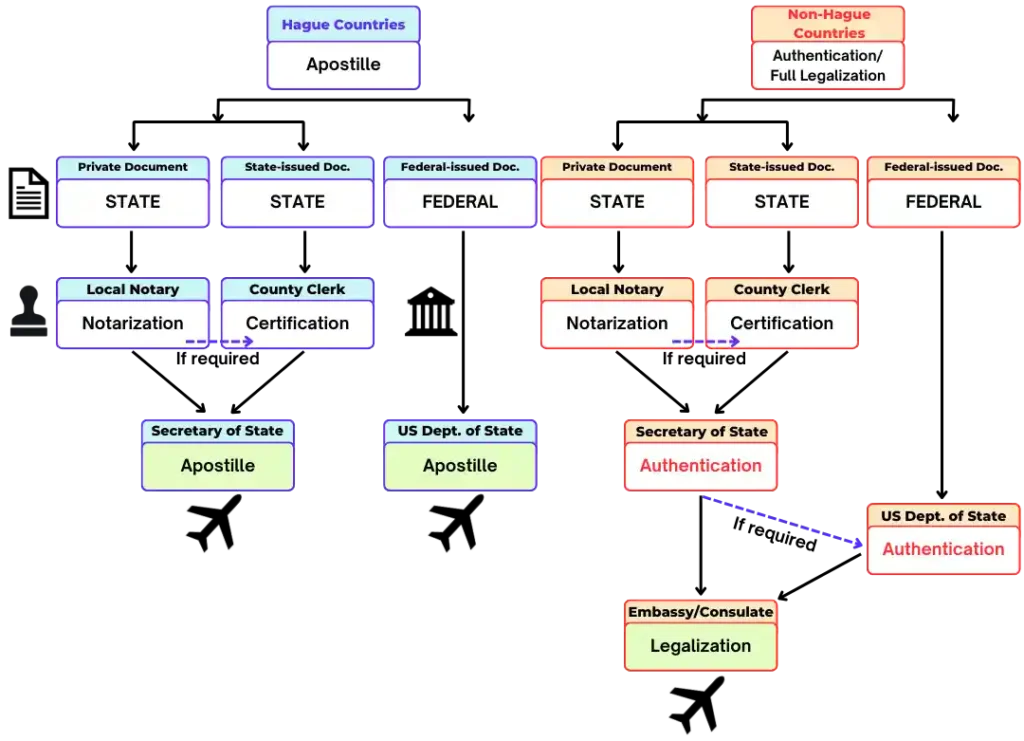
Authentication is the process of verifying a public document (such as a birth certificate, marriage certificate, or academic record) to ensure it is legally recognized abroad. The authentication procedure depends on whether the destination country is a member of the Hague Apostille Convention. If it is a member, the document will be authenticated using an apostille. If it is not a member, the document will undergo full legalization for authentication. Learn more about the Hague Conference and the ABCs of Apostilles.

Apostille Procedure
If the destination country is a member of the Hague Apostille Convention, the Secretary of State (or designated authority) issues an apostille certificate for both state/county-issued documents and private/corporate documents. For federal government-issued documents, including FBI background checks, the U.S. Department of State issues the apostille certificate.
Full Legalization Procedure
If the destination country is not a member of the Hague Apostille Convention, the document must go through full legalization. This usually involves:
Be advised that the roster of Hague Convention countries is subject to change. For the most current and official list, refer to the following link: HCCH Status Table
Authentication At a Glance
The apostille and full legalization procedures are outlined below.
Types of Documents That Are Typically Required for an Apostille
How to request an FBI background check:
Because the FBI is a federal agency, FBI background checks are typically submitted to the U.S. Department of State – Office of Authentications in Washington, D.C. for issuance of an apostille or authentication certificate.
State offices, such as the California Secretary of State, generally do not authenticate federal documents.
Academic documents generally need to contain a notarized signature or an official certification before they can be submitted for apostille.
Two common ways:
The California Secretary of State issues a single Apostille for documents intended for use outside the United States, regardless of the country of destination. To be eligible for apostille, documents generally must bear the signature of a California public official or contain a properly notarized or certified signature. Plain photocopies without notarization or certification are typically not accepted.
For more information on obtaining an apostille or authentication certificates from the U.S. Department of State or from individual state authorities, please visit this resource.
Verify your California state Authentication Certificate (Apostille) here and track the status of your federal document here.
Our Nationwide Apostille & Document Legalization Services
Facilitating authentication for documents intended for international use across all jurisdictions: